Can You Send Bulk WhatsApp Messages for Free? An Honest Answer
What free bulk WhatsApp messaging actually gets you in 2026 — the genuinely free methods, where each one stops working, and how to tell a real free plan from a trial with a countdown.
Quick answer
Yes, with limits. WhatsApp's built-in broadcast list is free but caps at 256 contacts and only reaches people who saved your number. Free plans on bulk tools are real but capped — BulkWA's free plan is 50 messages a day, forever, with a small 'Sent via BulkWA' note. Unlimited free bulk messaging does not exist; the useful skill is spotting which limit you are agreeing to.
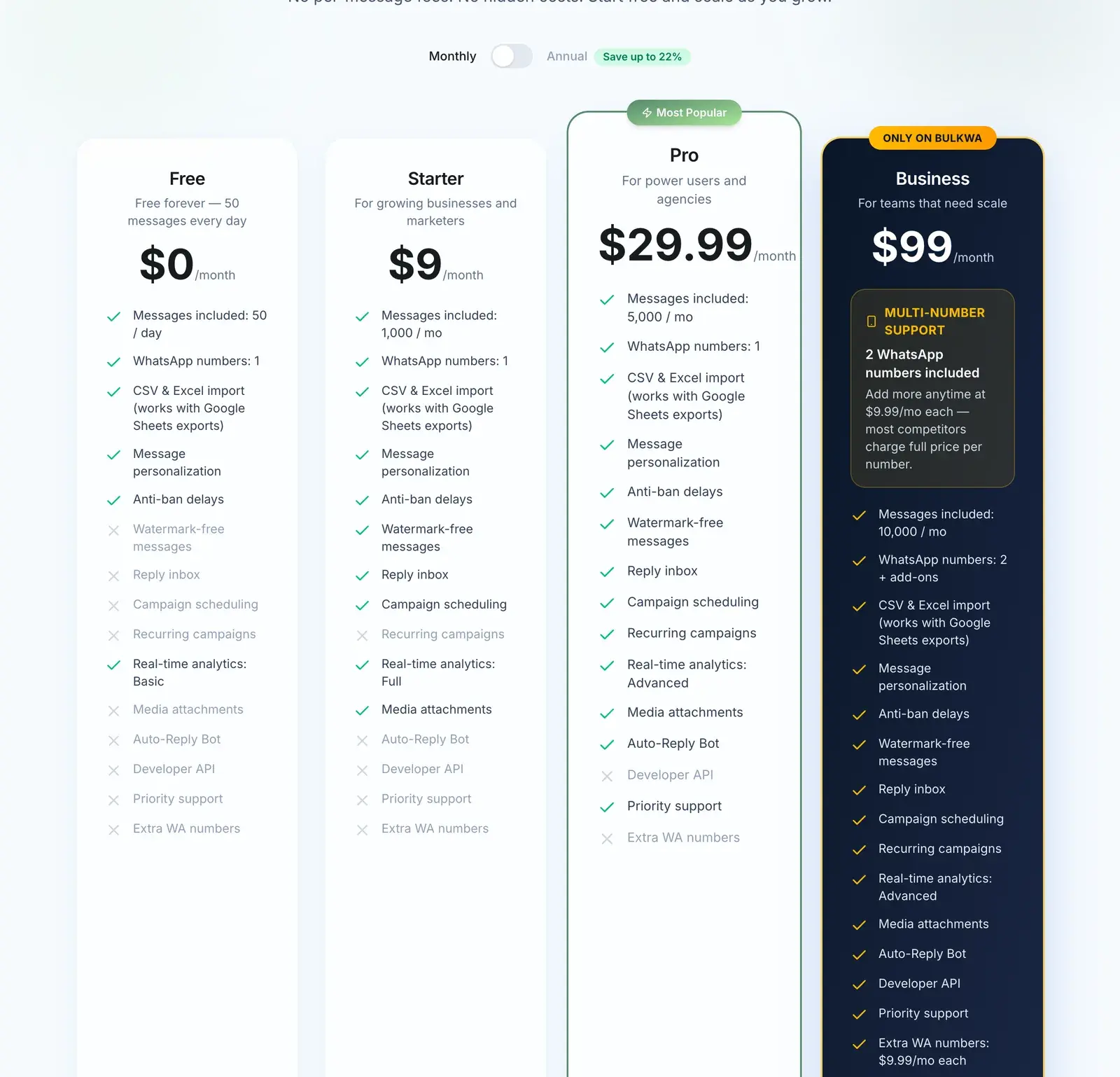
Short answer: yes, free bulk WhatsApp messaging exists — but every free option has a limit, and the useful skill is spotting which limit you are agreeing to. WhatsApp's own broadcast list is free and reaches up to 256 saved contacts. Free tool plans are real but capped, usually with a watermark or a daily ceiling.
What does not exist is unlimited free bulk messaging. Anyone advertising it is either running a trial clock, adding a watermark, or monetising your contact list.
The Genuinely Free Methods
1. WhatsApp Broadcast Lists — Free, Built In, Badly Limited
WhatsApp includes broadcast lists at no cost. You create a list, add contacts, send once, and each person receives it as an individual message rather than a group chat.
The two limits that matter:
- 256 contacts maximum per list.
- Recipients only receive it if they have your number saved in their phone.
That second one is the killer, and most people do not know about it. If 180 of your 256 contacts have not saved your number, 180 people receive nothing — and WhatsApp shows you no error. The message appears sent. You conclude the campaign underperformed when it mostly never arrived.
Also missing: personalization (everyone gets identical text, which is both less effective and a ban signal), scheduling, delivery reporting, and any way to handle replies at volume.
Genuinely useful for: a small list of regulars who already have you saved. A neighbourhood shop messaging 40 loyal customers is a perfect fit.
2. wa.me Links — Free, Official, One at a Time
WhatsApp's Click to Chat link opens a conversation with any number without saving it, and can pre-fill text. Free, official, and no ban risk.
It does not send automatically — a human presses send each time. For a website button or a QR code on a flyer it is excellent. For 300 recipients it is 300 manual actions.
3. Free Plans on Bulk Tools
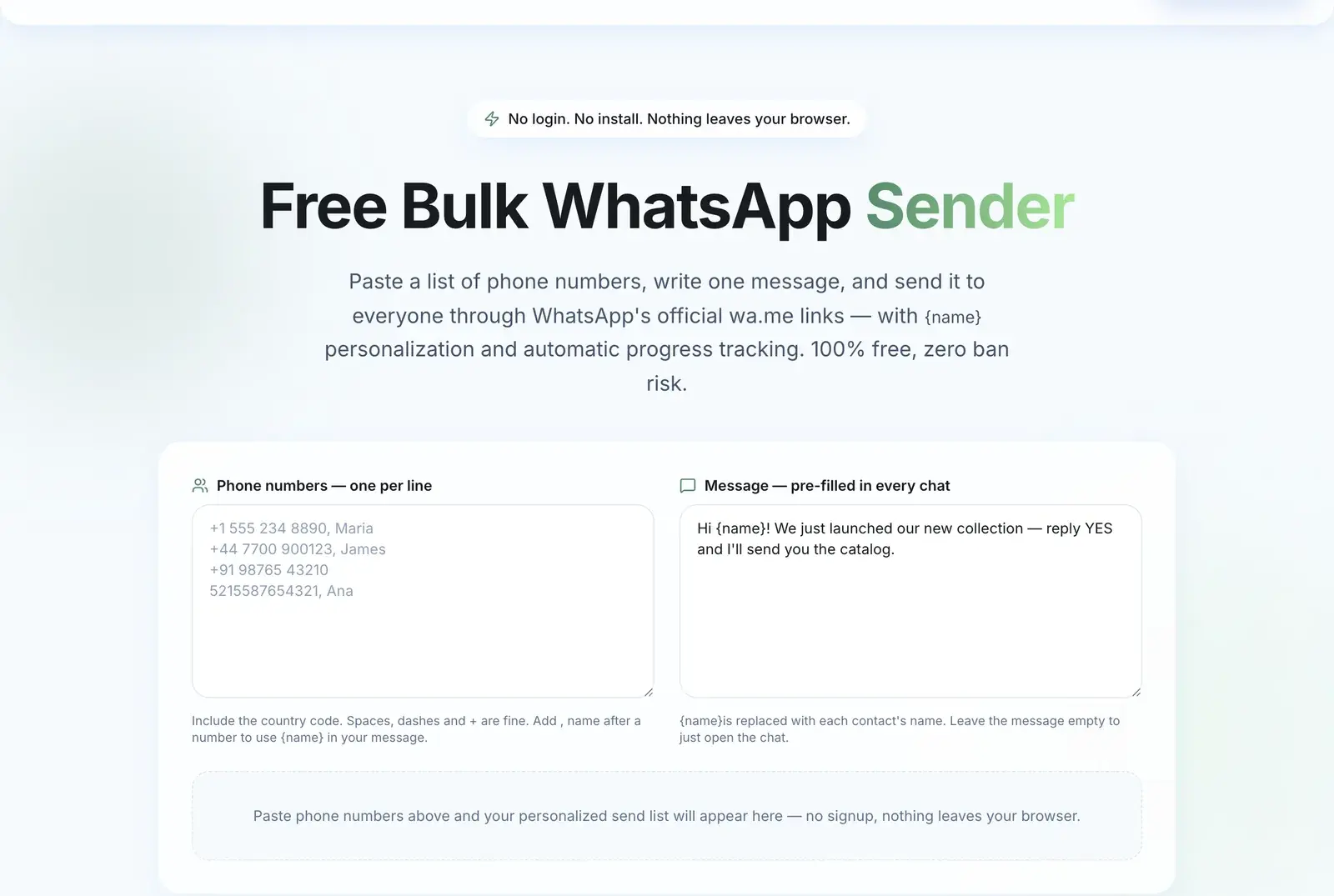
Most bulk tools offer a free tier. They vary enormously in honesty.
BulkWA's free plan, for reference: 50 messages per day, free forever, one WhatsApp number. Campaign messages carry a small "Sent via BulkWA" note, which paid plans remove. That is the catch, stated up front. Fifty a day is 1,500 a month, which is a real working volume for a small business — and the watermark is the reason it can stay free.
The Four Catches, and How to Spot Them
Every free offering in this market has one. Learn to identify which:
1. A watermark. Your messages carry the vendor's name. Honest, visible, and usually the least harmful trade — though it does look less professional to your customers.
2. A trial clock. "Free" means 7 or 14 days, then payment. Perfectly legitimate, frequently disguised. Look for the words "free trial" rather than "free plan", and check whether a card is required up front.
3. A cap so low it is a demo. 20 messages total, or 5 per day. Enough to see the interface, not enough to run anything.
4. Your data is the product. The one to actually worry about. Some free tools harvest the contact lists you upload. Your customer database is worth more than a subscription fee. Before uploading a list anywhere, read what the privacy policy says about how your contacts are used — and be especially careful with tools that have no privacy policy at all.
What to Avoid Entirely
Free browser extensions that automate WhatsApp Web. These are everywhere and they are the fastest route to a banned number. The typical implementation fires identical messages back to back with no delay — precisely the fingerprint WhatsApp's automated systems detect. They also usually request permission to read all data on the page, which on WhatsApp Web means your messages and your contacts.
The extension is free. The number is not.
Cracked or "unlimited" desktop senders. Frequently bundled with malware, and the sending behaviour is as crude as the extensions.
Anything asking for your 6-digit WhatsApp verification code. WhatsApp has no password; that code is the entire key to your account. Legitimate tools use QR pairing, which you revoke any time from Linked Devices on your phone. A request for the SMS code is an account theft attempt, without exception.
When Free Stops Being Enough
Free works until one of these becomes true:
- You need personalization. Identical messages convert worse and are a stronger ban signal than personalized ones. This is usually the first wall people hit.
- Your list outgrows 256, or too few contacts have saved your number.
- You need to know what happened. Free methods give you no delivery, read, or reply data, so you cannot tell a failed campaign from a failed list.
- You need scheduling. Sending at 9am on Tuesday should not require you to be awake and holding your phone.
- Replies become unmanageable in a normal chat list.
- The watermark starts costing you more in perceived professionalism than the subscription would cost in money.
The Real Cost Comparison
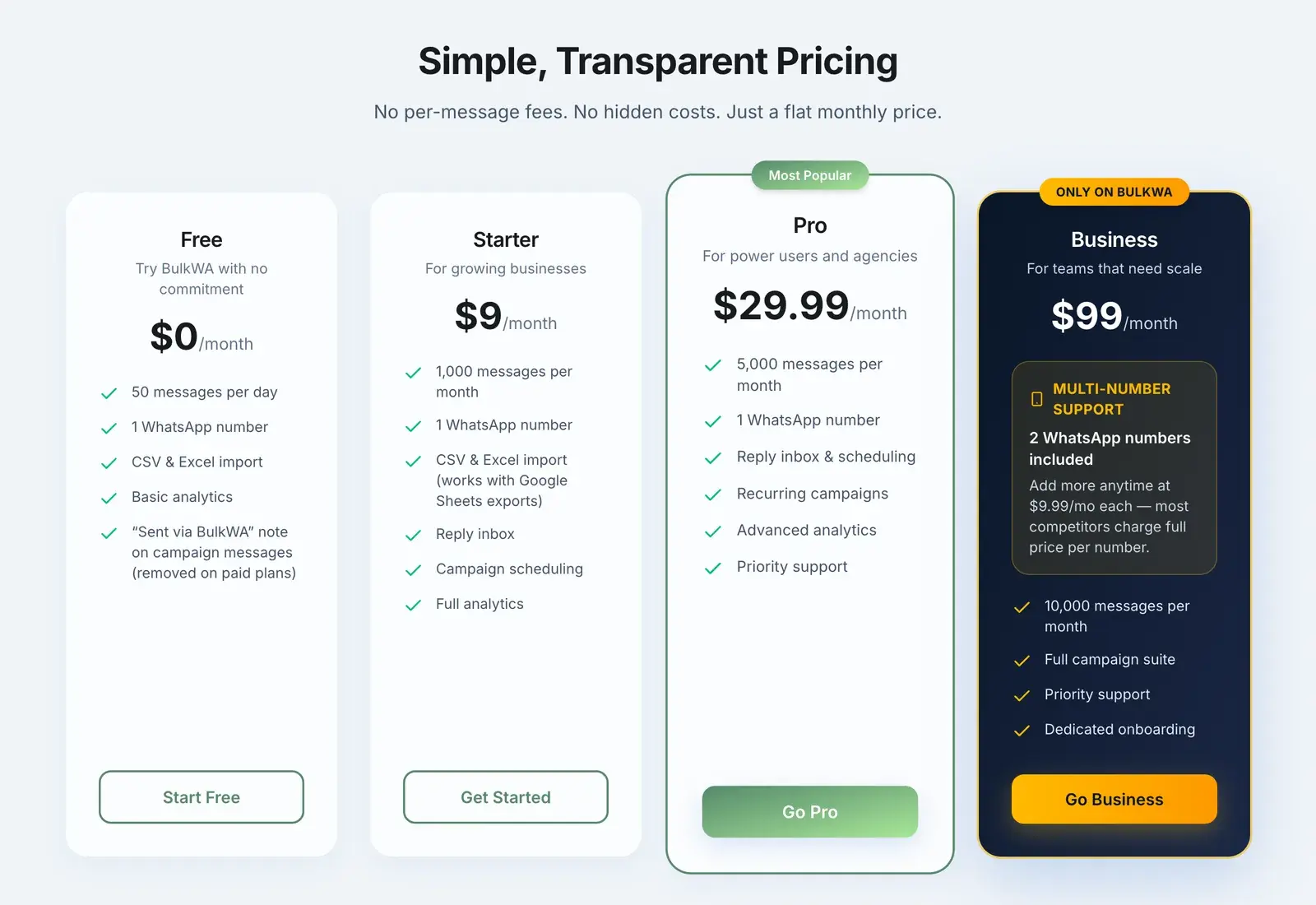
Worth doing the arithmetic honestly. If a paid plan is 9 dollars a month for 1,000 messages, that is 0.9 cents per message. The question is not whether 9 dollars is more than zero — it obviously is. The question is whether personalization, scheduling, delivery reporting and no watermark are worth 0.9 cents per send.
For most businesses with something to sell, one additional converted customer covers the year.
But if you are messaging 40 regulars who all have your number saved, the free broadcast list is genuinely the correct tool and you should not pay anyone. That is a real answer, not false modesty.
Free Does Not Mean Risk-Free
An important point that gets lost: the ban risk is identical whether you paid or not. WhatsApp does not know or care what your tool costs. It reacts to sending behaviour and to how recipients respond.
A free tool that blasts identical messages with no delay is more dangerous than a paid one with randomized delays and personalization — not because of the price, but because of the behaviour. Some free options are riskier precisely because they skip the safety mechanics that cost engineering effort to build.
And regardless of tool: messaging people who never opted in is what gets numbers banned. That is free to avoid.
Our Recommendation
Start free, and start with the option that matches your list. Forty regulars who have your number saved: use WhatsApp's broadcast list and pay nobody. A few dozen contacts you want to message once: BulkWA's free link tool, no signup. A real list that needs personalization and a delivery report: BulkWA's free plan, 50 a day with the watermark, no card. Upgrade to Starter at $9 the day the watermark or the daily cap costs you a sale — and not before. Whatever you choose, remember the ban risk does not know what you paid; it only knows whether the people wanted the message.
The Bottom Line
Start free. Genuinely — use WhatsApp's broadcast list if your audience is small and has you saved, or a free plan if you want personalization and reporting at low volume.
Move to paid when the limits start costing you more than the subscription. That threshold arrives sooner than most people expect, usually at the moment they realise identical un-personalized messages are not landing.
Just know which catch you accepted, and never let the free thing be your contact list.
Frequently Asked Questions
Can I send bulk WhatsApp messages for free?+
Yes, but with real limits. WhatsApp's built-in broadcast list is free and sends to up to 256 contacts at once, though only recipients who have saved your number will receive it. Free plans on bulk tools typically cap you at a modest daily volume — BulkWA's free plan allows 50 messages per day with a small 'Sent via BulkWA' note appended — which is genuinely free but not unlimited.
Is WhatsApp's broadcast list really free?+
Yes, broadcast lists are a built-in WhatsApp feature with no cost. The catch is not money, it is reach: a list holds a maximum of 256 contacts and recipients only receive the message if they have your phone number saved in their address book. WhatsApp gives you no warning when someone does not receive it, so a broadcast can silently reach a fraction of your list.
What is the catch with free bulk WhatsApp tools?+
There is always one, and it is usually one of four things: a watermark appended to your messages, a trial that expires after 7 to 14 days, a message cap low enough to be a demo rather than a plan, or the tool harvesting your contact data. A free tier without any catch does not exist in this market, so the useful question is which catch you can live with.
Are free WhatsApp bulk sender browser extensions safe?+
Generally no. Free Chrome extensions that automate WhatsApp Web typically send identical messages with no delay, which is the behavioural pattern most likely to get a number banned. Many also request broad permissions to read page data, which on WhatsApp Web means access to your message content and contact list. The extension costs nothing and the banned number costs a great deal.
Ready to Try BulkWA?
Send bulk WhatsApp messages with personalized templates. Free to start, no credit card required.
Get Started Free