WhatsApp API Cost Per Message in 2026: Rates by Country
TL;DR
On Meta's rate card effective October 1, 2026, a delivered marketing message to the United States or Canada costs $0.025 and a utility message $0.0034. The rate depends on the recipient's country: marketing is $0.1365 in Germany and $0.0118 in India. Each number gets 1,000 free service replies a month before those are charged too, and BSPs add their own fees.
Since July 1, 2025, the WhatsApp Business API has no monthly subscription from Meta and no per-conversation fee. You pay for each template message that is delivered, and the price depends on two things: where the recipient lives and what kind of message it is. The same 1,000-person send can cost $11.80 or $136.50 in Meta fees depending on the country.
This guide is the rate table and the arithmetic. Every rate below comes from Meta's rate card effective October 1, 2026, as published in Meta's official pricing calculator and checked on October 31, 2026. If you want your own number rather than ours, plug your country and volume into the free WhatsApp API cost calculator.
How Does WhatsApp Business API Pricing Work in 2026?
Meta bills per delivered template message. Three things set the price of each one:
- The recipient's country. A message to a number in Germany costs more than the same message to a number in Mexico, whatever country your business is in.
- The category of the template. Meta has three: marketing (offers, announcements, re-engagement), utility (order confirmations, delivery and account updates) and authentication (one-time passcodes).
- Your monthly volume, for some categories. Utility and authentication have volume tiers, so the per-message rate falls as you send more. Marketing has no volume tiers: the 100,000th marketing message costs the same as the first.
Two more rules shape the bill. When a customer messages you, a 24-hour customer-service window opens, and your free-form replies inside it are service messages: since October 1, 2026, each number gets 1,000 free a month, and Meta charges for service messages after that. And Meta reviews template categories, so a template submitted as utility that contains promotional content can be treated as marketing and priced as marketing.
For how this fits alongside the free app, see is WhatsApp Business free? This post stays on the per-message rates.
What Does Each Message Cost by Country?
These are Meta's rates in US dollars per delivered message, from Meta's rate card effective October 1, 2026. Utility rates are the base (lowest-volume) tier. Authentication rates are listed on Meta's pricing page.
| Market | Marketing per message | Utility per message | 1,000 marketing messages |
|---|---|---|---|
| United States & Canada | $0.025 | $0.0034 | $25.00 |
| United Kingdom | $0.0635 | $0.022 | $63.50 |
| Germany | $0.1365 | $0.055 | $136.50 |
| France | $0.0859 | $0.03 | $85.90 |
| Spain | $0.0707 | $0.02 | $70.70 |
| India | $0.0118 | $0.0014 | $11.80 |
| Brazil | $0.0625 | $0.0068 | $62.50 |
| Mexico | $0.0397 | $0.0085 | $39.70 |
| United Arab Emirates | $0.0576 | $0.0157 | $57.60 |
| Saudi Arabia | $0.0576 | $0.0107 | $57.60 |
Two things stand out. Marketing costs several times more than utility everywhere: in the US and Canada it is about seven times more, and in India more than eight. And Western Europe is the expensive end of the map, with Germany's marketing rate more than five times the US one.
Countries not listed by name fall into regional rates. "Rest of Western Europe" is $0.0592 for marketing and $0.0171 for utility, for example. Meta changes its rates at the start of a quarter, so check the effective date on any table you rely on, including this one.
How Is the Monthly Bill Calculated?
The formula is simple once you separate the pieces:
- Count the template messages delivered in the month, split by recipient country and category.
- Multiply each group by its rate from the table.
- Add the groups together. Free-form replies add nothing to Meta's part until a number passes 1,000 service messages in a month; above that, add them at Meta's service rate.
- Add your BSP's monthly fee and per-message markup, if you use one.
A worked example: a US shop sends 3,000 order and shipping updates (utility) and one 1,000-message promotion (marketing) to customers in the United States and Canada. Utility is 3,000 x $0.0034 = $10.20. Marketing is 1,000 x $0.025 = $25.00. Meta's part of the bill is $35.20. Every customer question answered inside the 24-hour window costs nothing extra from Meta.
Notice what drives the total: the marketing message. A business that mostly sends transactional updates pays very little per month on the API. A business whose main use is promotions pays the marketing rate on every message, with no discount for volume.
What Do BSPs Add on Top of Meta's Rates?
Few small businesses call Meta's Cloud API directly, because it means building and hosting the integration yourself. Most go through a Business Solution Provider (BSP), and each prices differently. These are approximate figures from each provider's public pricing page, checked on October 31, 2026:
- Direct Meta Cloud API: Meta's rates only, with your own development and hosting.
- Twilio: Meta's rate plus about $0.005 per message.
- Wati (Growth plan): about $59 a month billed annually, plus Meta's rates with Wati's own markup on top; Wati publishes the markup in its rate card, so check the current figures there.
That turns $0.025 for a US marketing message into about $0.03 on Twilio; on Wati it is $0.025 plus Wati's markup, on top of the monthly fee. The cost calculator applies Twilio's fee and Wati's monthly fee for you, so you can compare providers for your own country and volume.
What Do 1,000 or 5,000 Marketing Messages Cost?
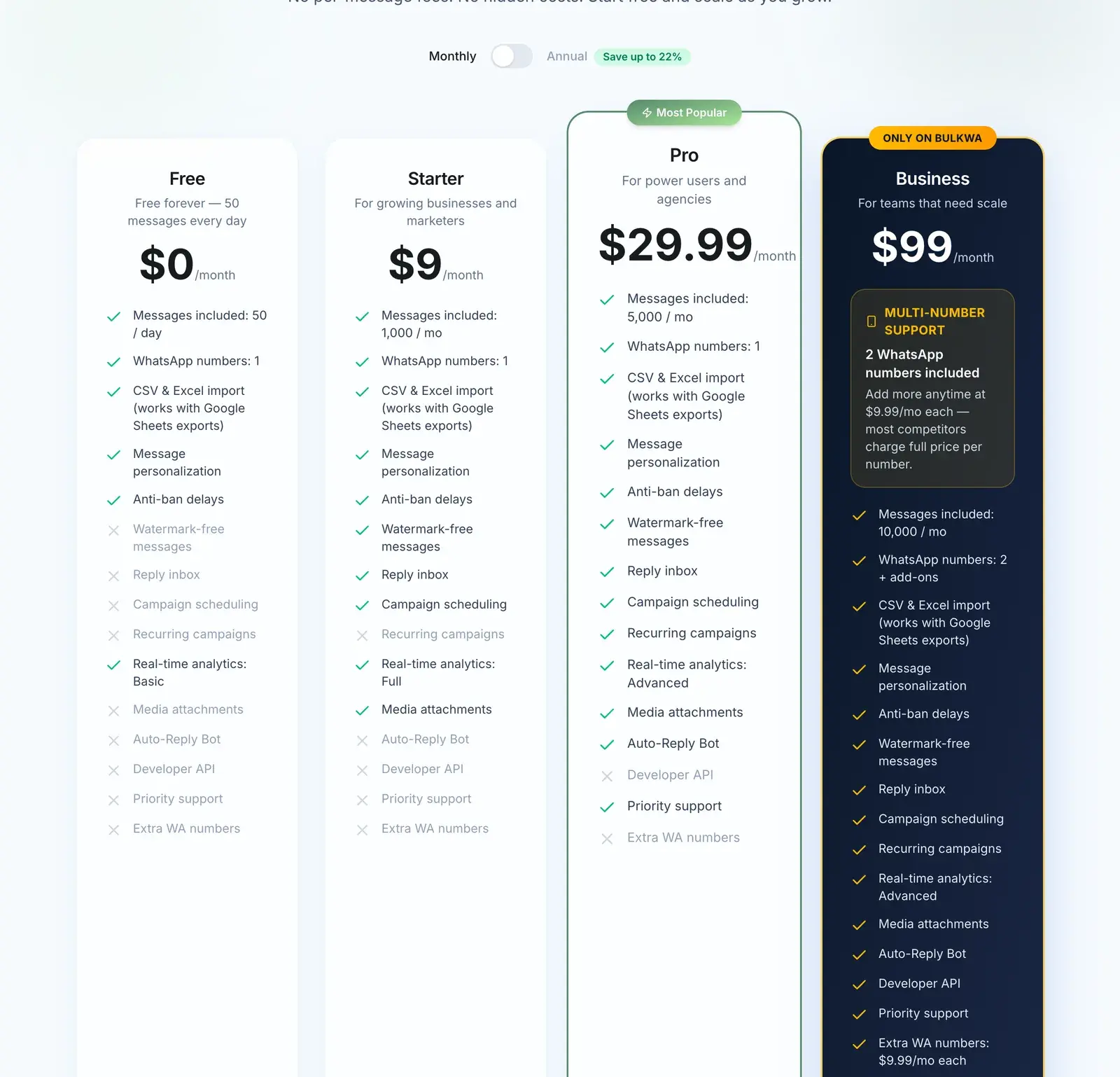
Here is the US and Canada marketing rate of $0.025 at two common volumes, set against BulkWA's flat plans. The BSP columns are estimates from the figures above; the Wati column is the $59 plan plus Meta's rates, before Wati's own markup.
| Monthly marketing messages | Meta fees, direct API | Via Twilio, est. | Via Wati Growth, before markup | BulkWA flat plan |
|---|---|---|---|---|
| 1,000 | $25 | $30 | $84 plus markup | Starter, $9 a month |
| 5,000 | $125 | $150 | $184 plus markup | Pro, $29.99 a month |
In Germany, the same 1,000 marketing messages are $136.50 in Meta fees alone, before any BSP.
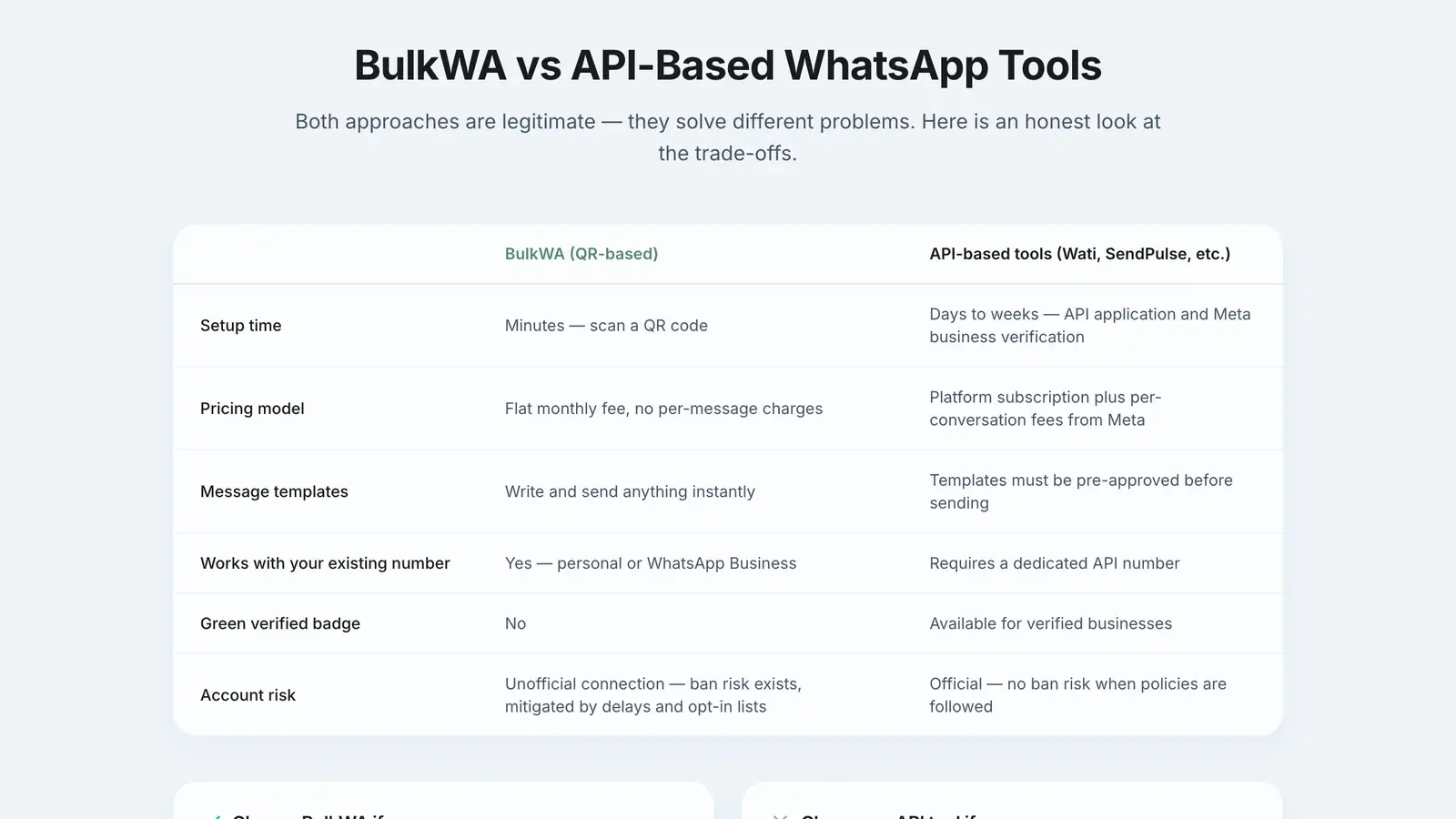
The comparison is real, but it is not like-for-like. The API is the official WhatsApp Business Platform: approved templates, a path to the verified badge, integrations your developers can build on, and no risk of a ban for using an unofficial client on approved volume. For enterprises, banks, healthcare providers and anyone in a regulated industry, or anyone sending authentication codes, it is the right choice and the per-message fee is the price of that standing. BulkWA is an unofficial QR-based sender that uses your existing number, with a flat price and the risk on you. We lay out the full trade-off in BulkWA vs the WhatsApp Business API and the product differences in WhatsApp Business app vs API. For the wider picture across tools and volumes, see WhatsApp bulk sender pricing in 2026.
What Are the Risks of the Flat-Rate QR Alternative?
A QR-based sender pairs with your number the way WhatsApp Web does. It is not sanctioned by WhatsApp, and if WhatsApp restricts the number, the number that gets restricted is yours. What keeps it healthy:
- Opt-in only. Message people who asked to hear from you. Reports from recipients are the fastest route to a ban.
- Slow, randomized sending. BulkWA waits a random 8 to 20 seconds between messages by default. 1,000 messages take hours, not minutes.
- Warm up new numbers. A number that has never sent in volume should start small and build up over days.
- Personalize. Use {Name} and a relevant detail so each message reads like a real one, not a copy.
- Honour STOP. End campaigns with "Reply STOP to stop these messages". BulkWA unsubscribes anyone who replies STOP automatically.
The full checklist is in our anti-ban rules.
Where BulkWA Fits
If you need the official channel, verified status or authentication codes, pay Meta's per-message rates and pick a BSP whose markup you can live with. Run the numbers first in the WhatsApp API cost calculator.
If you are a smaller business sending promotions and reminders to customers who opted in, the per-message marketing rate is the line that grows fastest. BulkWA replaces it with a flat monthly plan: Free gives you 50 messages a day, Starter is $9 a month for 1,000 messages, Pro is $29.99 for 5,000, and Business is $99 for 10,000. We price every route for exactly 5,000 messages in the cheapest way to send 5,000 WhatsApp messages a month. There are no per-message fees on any plan. See the full pricing and features, or create a free account and send a test batch from your own number today.
What we will not claim: that a QR sender is official, or that it carries the API's guarantees. It is cheaper because it is a different product. Send to opted-in contacts, send slowly, and the flat plan does what it says.
Frequently Asked Questions
How much does a WhatsApp marketing message cost in 2026?+
It depends on the recipient's country. On Meta's rate card effective October 1, 2026, a delivered marketing message costs $0.025 in the United States and Canada, $0.0635 in the United Kingdom, $0.0625 in Brazil, $0.0118 in India and $0.1365 in Germany. Marketing has no volume discounts, and any BSP you use adds its own fee on top of Meta's rate.
How much does a WhatsApp utility message cost?+
Utility messages, such as order confirmations and delivery updates, are much cheaper than marketing. At the base volume tier on Meta's rate card effective October 1, 2026, a utility message costs $0.0034 in the United States and Canada, $0.022 in the United Kingdom, $0.0014 in India and $0.055 in Germany. Utility rates drop at higher monthly volumes.
Are WhatsApp Business API replies free?+
When a customer messages you, a 24-hour customer-service window opens. Your free-form replies inside it are service messages: since October 1, 2026, Meta gives each business number 1,000 free delivered service messages a month and charges its published service rate after that. Template messages you send to start a conversation, or after the window closes, are billed per delivered message by country and category. Your BSP may still charge its own fees for replies.
Do BSPs charge more than Meta's rates?+
Usually, yes. Using the Cloud API directly means paying only Meta's rates but building and hosting the integration yourself. Resellers add fees: as checked on October 31, 2026, Twilio published about $0.005 per message on top of Meta's rate, and Wati's Growth plan cost about $59 a month billed annually, with Wati's own markup added on top of Meta's per-message rates; check Wati's rate card for the current figures.
Is a flat-rate QR sender cheaper than the WhatsApp API?+
On price per message, often. BulkWA Starter is $9 for 1,000 messages a month, against $25 in Meta fees alone for 1,000 US marketing messages. They are different products, though. The API is official, gives you a verified-badge path and approved templates. A QR sender is an unofficial connection where the ban risk sits on your own number, so it suits opted-in lists sent slowly.
Ready to Try BulkWA?
Send bulk WhatsApp messages with personalized templates. Free to start, no credit card required.
Get Started Free