Is Bulk WhatsApp Messaging Legal? What the Rules Actually Say
Bulk WhatsApp messaging is legal when you have consent. This guide separates three different rulebooks — the law, Meta's policy, and your tool's terms — and explains what each one actually requires.
Quick answer
Bulk WhatsApp messaging is legal when every recipient gave prior, informed consent to hear from you on WhatsApp and each message offers a working opt-out. It becomes a legal problem — and a ban problem at the same moment — when you message purchased, scraped or repurposed numbers. Three separate rulebooks apply: data-protection law, Meta's business policies, and WhatsApp's terms on how you connect.
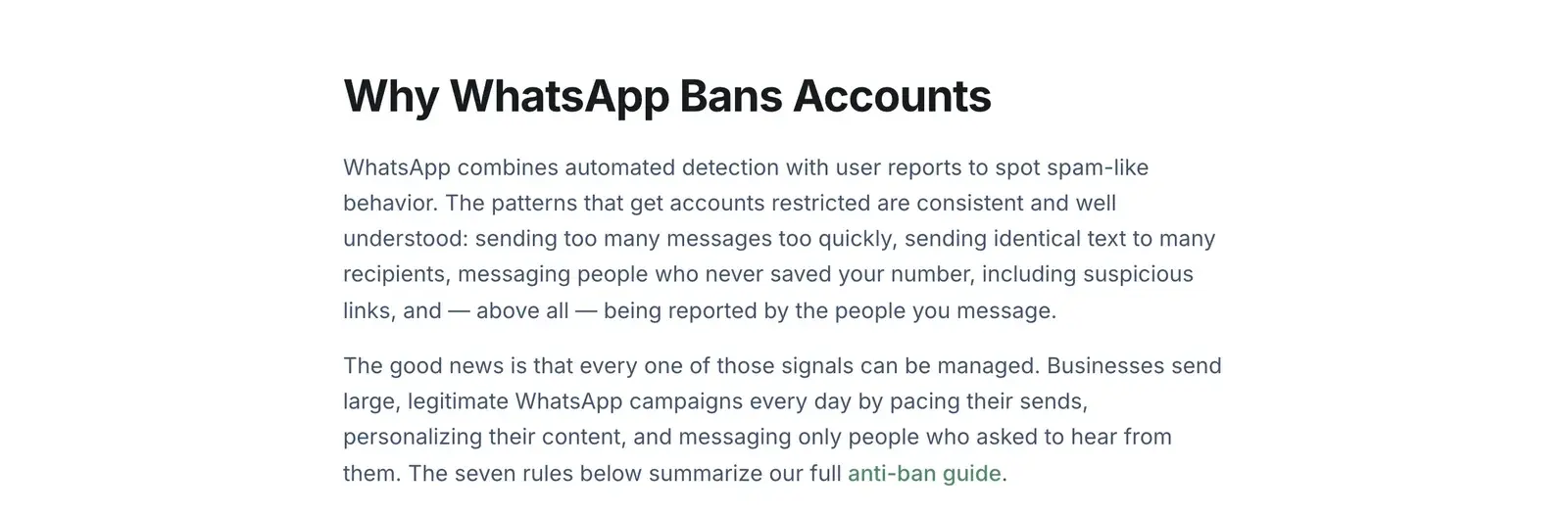
Short answer: bulk WhatsApp messaging is legal when you have consent. It becomes illegal — or at minimum against policy — when you message people who never agreed to hear from you, when you ignore opt-out requests, or when you cannot show where a number came from.
That answer is simple. What makes this topic confusing is that "am I allowed to do this?" is really three separate questions with three different answers, and most articles blur them together. Let us separate them.
Three Rulebooks, Not One
When you send a bulk WhatsApp campaign, you are subject to three independent sets of rules. You can comply with one and violate another.
1. The law of your country and your recipients' countries. This governs consent and data handling. In the EU and UK that is GDPR plus the ePrivacy rules. In the US it is a patchwork including the TCPA and state laws. Brazil has LGPD, India has the DPDP Act, and so on. Breaking these can mean regulatory fines.
2. Meta's WhatsApp Business Policy and Commerce Policy. This governs what you may send and to whom, regardless of what the law permits. Meta bans certain product categories outright and requires opt-in for business-initiated messages. Breaking these means your number gets restricted or banned.
3. WhatsApp's Terms of Service, which govern how you connect. This governs the mechanism. Automated or bulk sending outside the official Business API is not authorised. Breaking this also means a ban.
The important consequence: you can have perfect legal consent and still lose your number, because consent satisfies rulebook 1 and 2 but not rulebook 3. And you can be fully inside WhatsApp's technical rules while still breaking data protection law. Both matter.
What "Consent" Actually Means
This is where most businesses get it wrong, so it is worth being precise.
Consent, under GDPR and most comparable regimes, must be:
- Freely given. Not a condition of receiving something unrelated.
- Specific. Consent to WhatsApp marketing, not consent to "communications" in general.
- Informed. The person knew who you are and what you would send.
- Unambiguous. An affirmative action — ticking an unticked box, sending you a message, scanning a QR code with a stated purpose.
Things that are not consent, no matter how common they are:
- Having someone's number because they bought from you
- Having someone's number because they were in a WhatsApp group with you
- A pre-ticked opt-in box
- Consent buried in a terms-and-conditions link nobody opened
- A purchased list, a scraped list, or a list a colleague "had lying around"
- Consent given for order notifications, then reused for promotions
That last one catches a lot of otherwise careful businesses. Consent is purpose-bound. Someone who agreed to delivery updates has not agreed to your Black Friday campaign.
Keep the Receipts
If a regulator or Meta ever asks, "why did you have this person's number?", you need an answer with a date on it. Practically, that means recording, for each contact:
- When they opted in
- How they opted in (checkout checkbox, form, QR code, inbound message)
- What they were told they would receive
- When they opted out, if they did
This sounds bureaucratic until the first complaint arrives. A consent log is the difference between a resolved inquiry and an enforcement action. It is also, not coincidentally, the thing that keeps your ban rate low: a list you can account for is a list that does not generate block-and-report signals.
Opt-Out Is Not Optional
Every jurisdiction with electronic marketing rules requires a working, easy opt-out. On WhatsApp the convention is a STOP keyword, and it needs to actually work — not route to an inbox nobody reads.
BulkWA handles STOP automatically: a contact who replies STOP is suppressed from future campaigns without you doing anything. That is the floor, not a feature. If your tool does not do this, you are one annoyed recipient away from a complaint you cannot defend.
Honour opt-outs promptly and permanently. Re-adding someone who opted out — because they came back into a fresh CSV import — is one of the most common ways businesses turn a compliant list into a non-compliant one.
The Categories You May Not Message About
Independently of consent, Meta's Commerce Policy prohibits promoting certain things over WhatsApp. The restricted list includes alcohol and tobacco, drugs (including some supplements), weapons and ammunition, adult content and services, gambling, live animals, medical and healthcare products in several categories, and real money gambling services. Rules vary by country and Meta updates them.
Consent does not create an exemption. If your product is on the restricted list, a fully opted-in audience does not make the campaign compliant.
Where Unofficial Tools Sit — Including This One
We would rather say this plainly than let you find out later.
BulkWA pairs with the WhatsApp account you already own by QR code, the same mechanism as WhatsApp Web. That is outside the official Business API, which means it is outside WhatsApp's authorised automation. The risk of a restriction or ban is real, it is not zero, and it lands on your number, not on us.
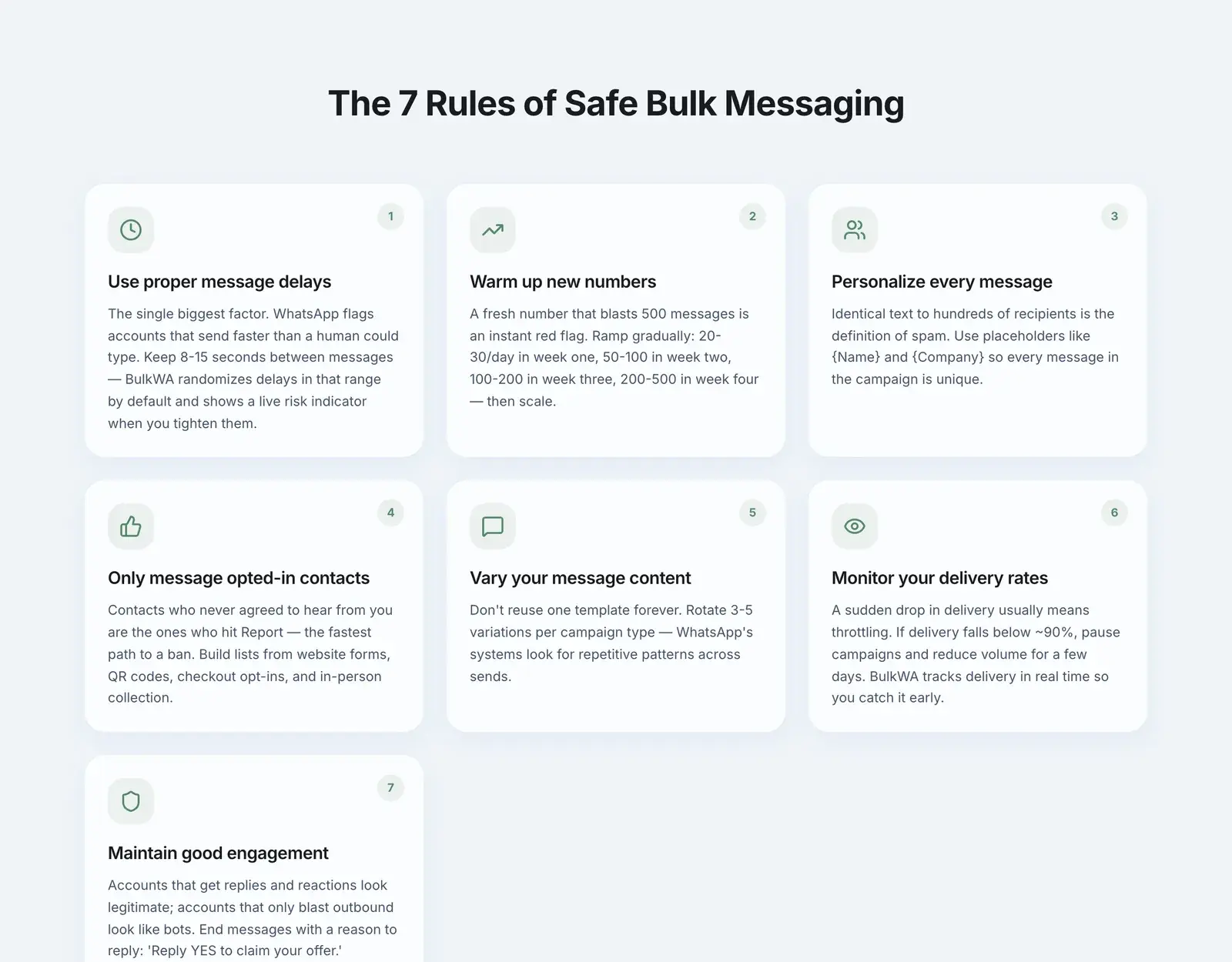
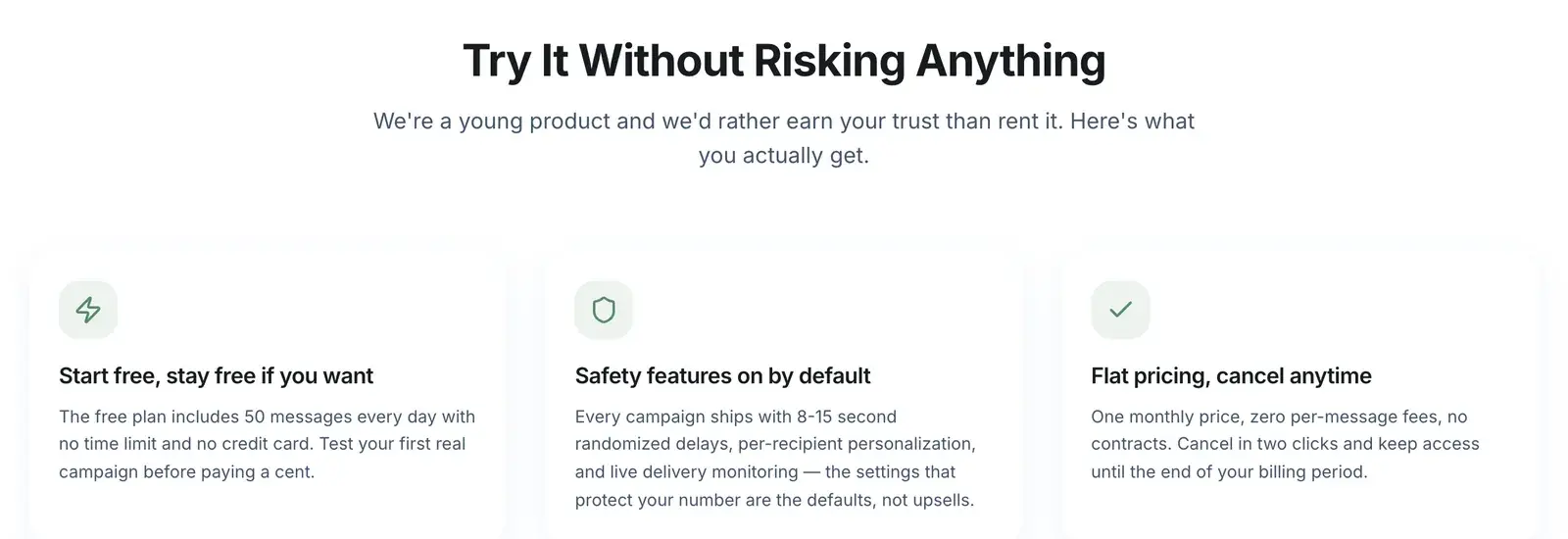
What we do about it: randomized delays between sends so traffic does not look machine-generated, per-recipient personalization so no two messages are byte-identical, an opt-in warm-up mode that caps daily volume on new numbers, automatic STOP handling, and live delivery monitoring so you see problems early. Those measures reduce the known ban signals. They do not eliminate the underlying risk, and no vendor can honestly claim otherwise.
If your business genuinely cannot tolerate any risk to its primary number — a hospital, a bank, a business where the WhatsApp line *is* the business — use the official WhatsApp Business API through a Business Solution Provider. It costs more and takes longer to set up, and it is the right call for that situation.
A Practical Compliance Checklist
Before you launch a campaign, you should be able to answer yes to all of these:
- Every number on this list opted in to WhatsApp messages from us specifically.
- I can show when and how each one opted in.
- The message matches what they opted in to receive.
- My product category is not on Meta's restricted list.
- There is a working opt-out, and previous opt-outs are suppressed.
- I am not sending from a number I cannot afford to lose, or I have accepted that risk.
- If I operate in the EU/UK, I have a privacy notice covering WhatsApp messaging and a lawful basis recorded.
If you cannot answer yes to number 1 and 2, the rest does not matter yet. Fix the list first.
Our Recommendation
If your list is people who opted in, a QR-based sender is a legitimate, low-cost way to reach them, and BulkWA is built so the compliance mechanics are on by default: automatic STOP suppression that survives re-imports, randomized delays, per-recipient personalization, and delivery monitoring. Keep a consent record for every contact — a source and a date column in your spreadsheet is enough — and you will be able to answer any question a regulator or Meta could ask. If your list is not opted in, no tool makes it legal; fix the list first.
The Honest Bottom Line
Bulk WhatsApp messaging is legal, widely used, and extremely effective when done to people who want to hear from you. It becomes a legal problem and a ban problem at the same moment — when you start messaging strangers. Those two risks are not independent; they have the same root cause.
The businesses that run WhatsApp campaigns for years without incident are not the ones with the cleverest tool. They are the ones with a list they built themselves.
Frequently Asked Questions
Is it legal to send bulk WhatsApp messages?+
Yes, sending bulk WhatsApp messages is legal in most countries as long as each recipient gave you prior, informed consent to be contacted on WhatsApp for that purpose, and every message offers a clear way to opt out. What is not legal in most jurisdictions is messaging purchased, scraped, or harvested numbers, or messaging people who gave you their number for an unrelated reason such as completing a delivery.
Do I need consent to send WhatsApp marketing messages under GDPR?+
Yes. Under GDPR, consent must be freely given, specific, informed and unambiguous, and it must be given for WhatsApp marketing specifically. Having someone's phone number is not consent. A pre-ticked box is not consent. Consent collected for order updates does not extend to promotional campaigns, and you must be able to show a record of when and how each contact opted in.
Can I get fined for bulk WhatsApp messaging?+
Yes. Data protection regulators can fine businesses for messaging people without a lawful basis — GDPR penalties reach up to 4% of global annual turnover or 20 million euros, whichever is higher, though fines at that scale are reserved for severe cases. Separately, many countries have their own electronic marketing rules with their own penalties. Losing your WhatsApp number to a ban is usually the faster and more likely consequence.
Is using a third-party bulk WhatsApp tool against WhatsApp's terms?+
WhatsApp's Terms of Service prohibit unauthorised automated or bulk messaging outside the official WhatsApp Business API. Tools that pair with your personal or Business-app account by QR code operate outside those terms, and the consequence — an account ban — falls on your number rather than on the tool vendor. This is a real risk that no tool can remove, and any vendor claiming otherwise is not being straight with you.
Ready to Try BulkWA?
Send bulk WhatsApp messages with personalized templates. Free to start, no credit card required.
Get Started Free