How to Send Automatic WhatsApp Follow-Ups That Don't Annoy People
Follow-up sequences send a second WhatsApp message automatically days after the first and skip anyone who replied. How to structure one, how many steps is too many, and how it works without the API.
Quick answer
A WhatsApp follow-up sequence is a campaign with timed steps: the first message goes out, then a second and third go automatically after a delay you choose — and anyone who replied is skipped. On BulkWA you attach follow-up steps to a campaign with an offset in days and a 'skip if replied' toggle, and it runs on your own number without the Business API. Two follow-ups is usually the ceiling; a third rarely earns its risk.
Most sales happen on the follow-up, and most follow-ups never get sent because nobody remembers. That is the case for automating them. The case against is that automated follow-ups are how a business turns into a nuisance — a third "just checking in!" to someone who never wanted the first message is how numbers get reported.
The difference is structure. Here is how to build a sequence that gets the second message out reliably without becoming the thing people block.
What a Sequence Actually Is
A sequence is a campaign with steps attached:
- Step 0 — the campaign itself. "Hi {Name}, your quote for {Service} is ready — reply YES to book."
- Step 1 — sent automatically N days later to anyone who has not replied. "Hi {Name}, wanted to make sure you saw the quote. Happy to answer any questions."
- Step 2 — optionally, one more, later again. "Last one from me — the quote is valid until {ExpiryDate}."
The crucial feature is the condition. Each step should send only to people who have not replied to any earlier step. On BulkWA, each follow-up step has a "skip if replied" setting, and every step carries its own offset in days from the previous one.
Because it is per recipient, everyone's clock is their own: someone who received the first message on Tuesday gets step 1 on Friday, someone who received it Wednesday gets it Saturday.
How Many Steps
Two, usually. Here is the honest arithmetic.
The first follow-up recovers a real share of people who meant to reply and forgot. That is worth automating.
The second follow-up recovers a much smaller share, and starts producing blocks from people who have now decided the answer is no. Worth it for a genuinely time-limited offer, where a deadline reminder is information rather than pressure.
The third and beyond recover almost nobody and produce mostly blocks. Blocks and reports are the strongest signal WhatsApp uses to restrict a number. A third follow-up is spending your number's reputation to reach people who already told you no by not replying twice.
If two follow-ups did not get a reply, the answer is no. Let it go.
Spacing
- First follow-up: 2–4 days after the original. Long enough to not crowd them, short enough that the original is still in memory.
- Second follow-up: another 3–5 days, or 24 hours before a deadline if there is one.
- Never same-day, unless the person explicitly asked for a same-day reminder.
- Respect hours. A follow-up landing at 6am reads as automated even if the content is perfect. Schedule steps into working hours in the recipient's timezone.
Write Each Step Differently
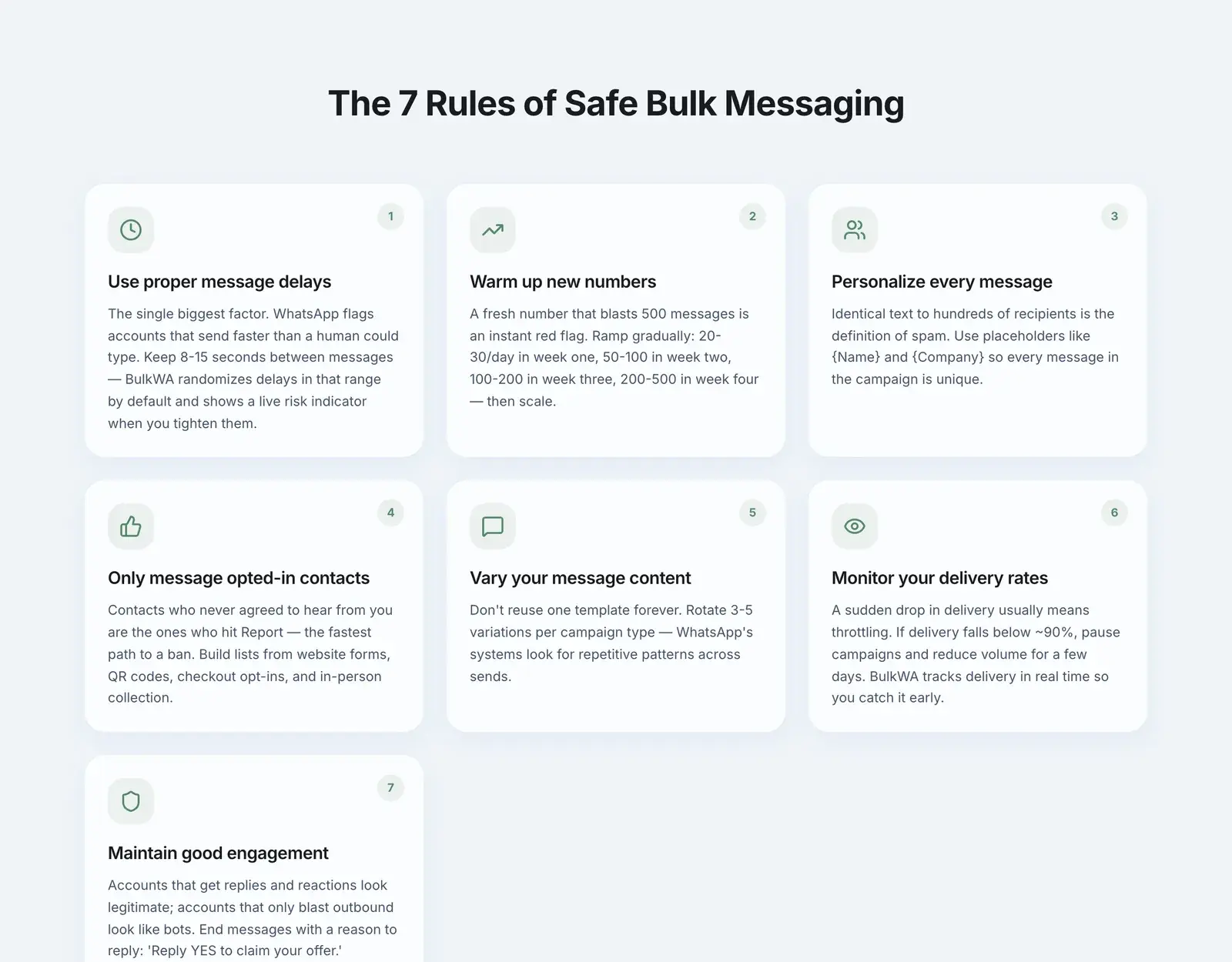
A follow-up that repeats the first message word for word is both ineffective and dangerous: ineffective because they already ignored those words, dangerous because identical repeated messages to the same number is a recognisable spam pattern.
Each step should add something:
- Step 1: remove friction. "Happy to answer questions" or "here's a direct booking link."
- Step 2: add a reason. A deadline, a limited quantity, a benefit they may have missed.
- Every step: keep the opt-out. "Reply STOP to unsubscribe" — and honour it instantly. Someone who opts out at step 0 must never receive step 1.
Personalization matters here as much as anywhere. A follow-up that references their specific quote, order or appointment reads as a person remembering; one that does not reads as a scheduler firing.
Where Sequences Shine
- Quotes and proposals. The follow-up is the sale.
- Abandoned bookings or carts. "You started booking {Service} — want me to hold the slot?"
- Appointment confirmations. Reminder at 3 days, again at 24 hours.
- Renewals. 14 days before, 3 days before.
- Event RSVPs. Where a deadline genuinely exists.
Where they do not belong: cold outreach to people who never asked to hear from you. A sequence multiplies whatever you point it at. Pointed at an opted-in list it multiplies replies. Pointed at strangers it multiplies reports.
Where BulkWA Fits
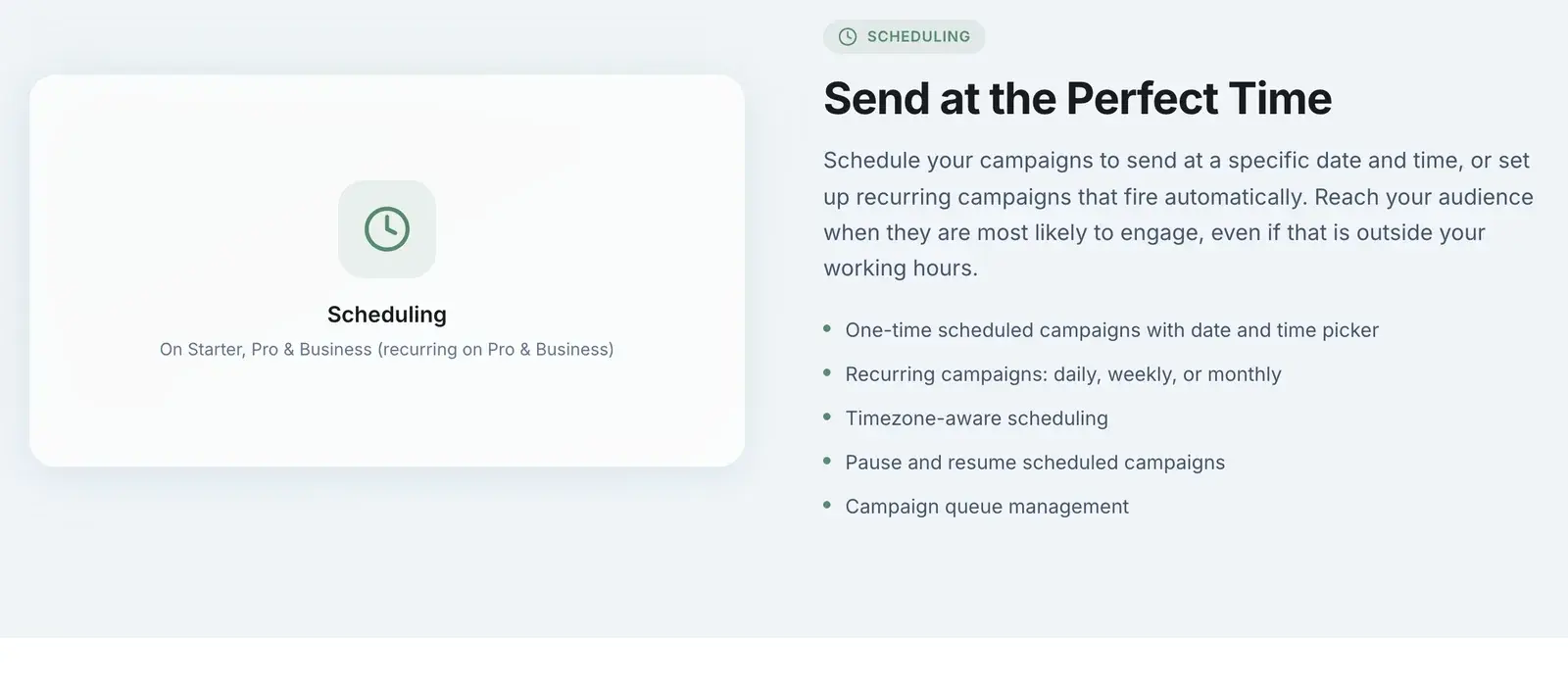
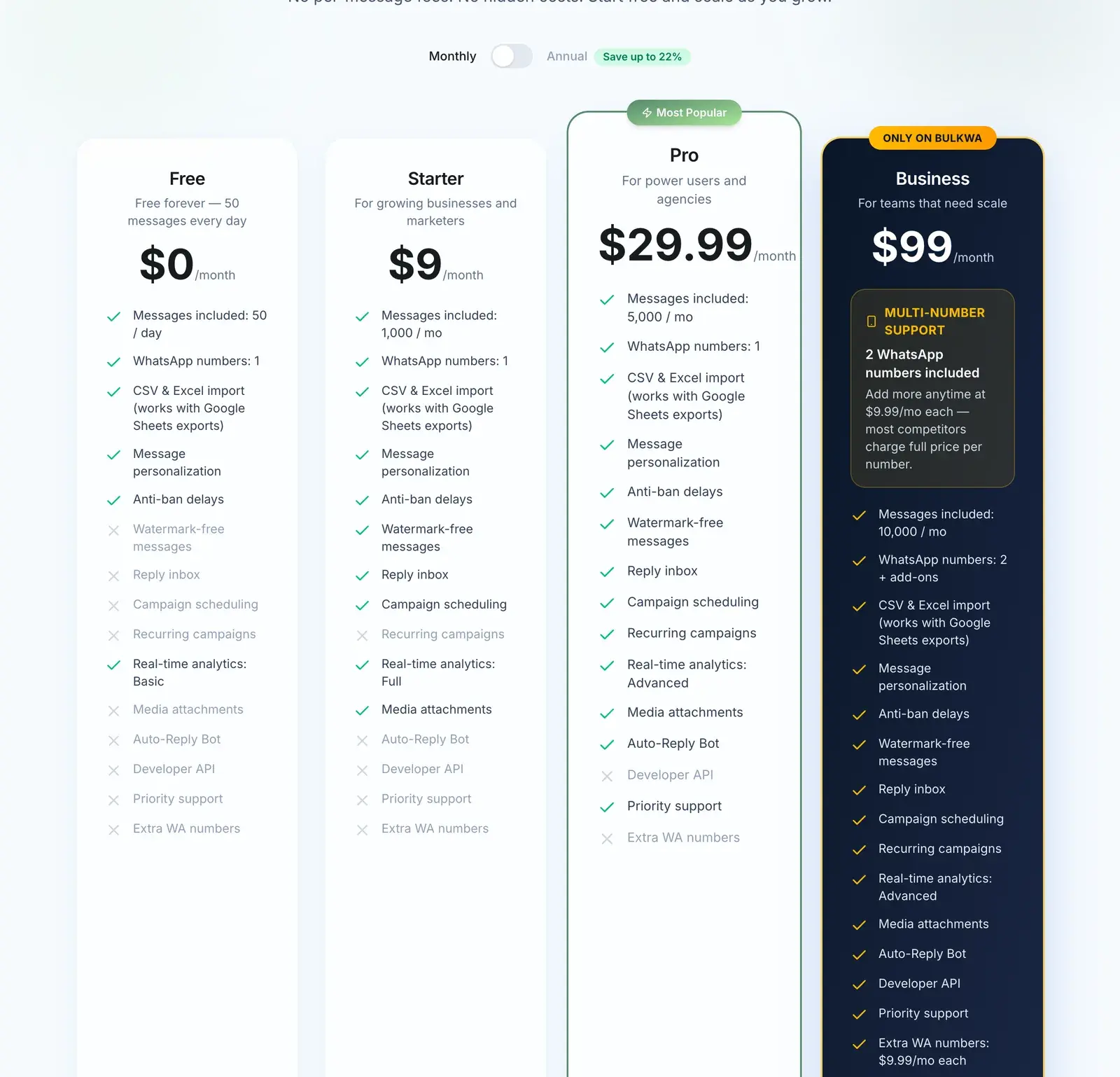
Follow-up sequences are included on BulkWA's Pro and Business plans. You attach steps to any campaign with an offset in days, a "skip if replied" toggle per step, and the same placeholders and personalization as the main message. Steps run on your connected number, are spaced with the same randomized anti-ban delays as campaigns, and STOP opt-outs are honoured across every step automatically.
Recurring campaigns — daily, weekly or monthly sends to a list — live on the same plans, for the reminders that repeat on a calendar rather than after a trigger.
The honest caveat is unchanged from every QR-based feature: this runs outside the official API, and the ban risk sits on your number. Sequences make that risk more sensitive to list quality, not less. Two steps, opted-in contacts, varied content, skip on reply — that is a sequence that keeps working.
Frequently Asked Questions
How many follow-up messages should I send on WhatsApp?+
Two, at most. A first message plus one follow-up a few days later catches most of the people who meant to reply and forgot. A second follow-up occasionally helps for time-limited offers. A third or beyond produces more blocks and reports than replies, and blocks are the signal that gets numbers restricted. If two follow-ups did not get a response, the answer is no.
Should follow-ups stop when someone replies?+
Always. Sending a scheduled 'just following up' to someone who replied yesterday is the fastest way to look like a bot, because it is bot behaviour. Every follow-up step should be conditional on no reply. BulkWA's sequence steps have a 'skip if replied' setting for exactly this, and it should be on for essentially every step.
How long should I wait between WhatsApp follow-ups?+
Two to four days for the first follow-up is a sensible default: long enough not to crowd them, short enough that they remember the original message. For a time-limited offer, a final follow-up 24 hours before the deadline works well. Same-day follow-ups almost always read as pressure and should be avoided unless the person asked for a same-day reminder.
Can I do WhatsApp follow-up sequences without the Business API?+
Yes. QR-based tools like BulkWA run sequences on your connected number: you attach follow-up steps to a campaign with a delay in days, and the tool sends them automatically, skipping anyone who replied. The same honesty applies as to any QR-based sending — it sits outside WhatsApp's official API and carries ban risk on your number, which is one more reason to keep sequences short and to opted-in contacts.
Ready to Try BulkWA?
Send bulk WhatsApp messages with personalized templates. Free to start, no credit card required.
Get Started Free